
Following on my previous blog on knitting methods and styles, we are now taking a look at how it is actually done.
Unless you knit left-handed, the stitches sit on the left needle, and the right needle is the working needle that creates the new stitches. For left-handed knitters, this setup must be swapped around. From here on, I will only refer to right-handed knitting, also because being mostly left-handed myself, it never occurred to me that there could be something like left-handed knitting, given that both hands are used, but everybody is different. Please get in touch with me, if you have questions related to left-handed knitting.
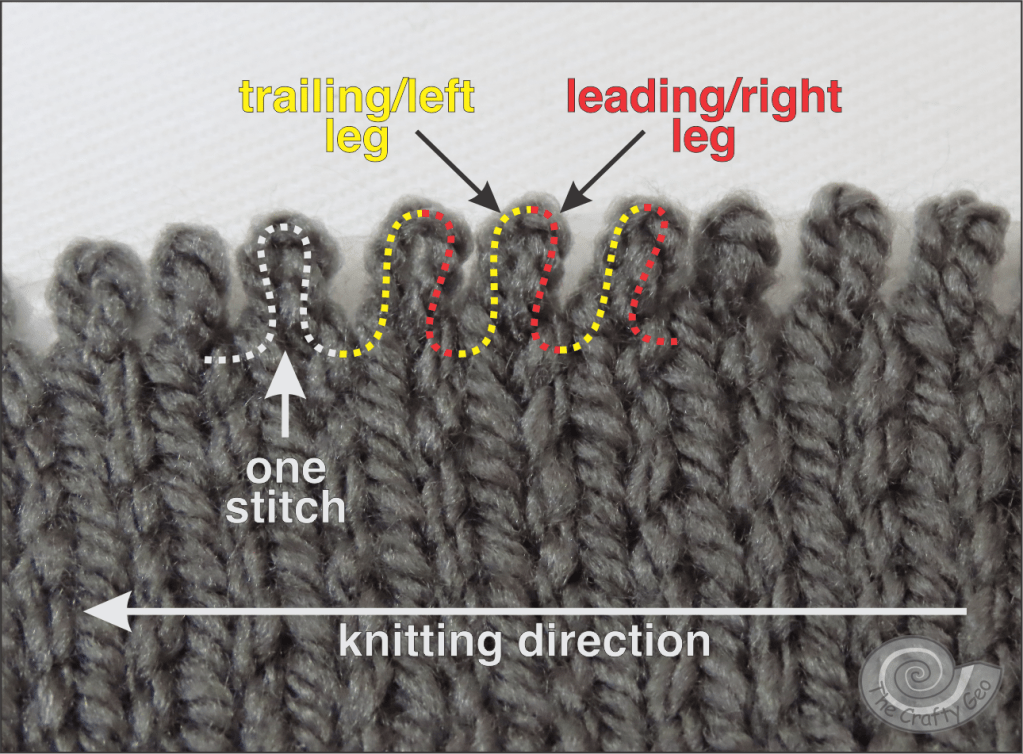
The following image illustrates the terminology we are going to use in the next few paragraphs.
Western knitting, which is the most common method, is characterised as follows:
- the leading (right) leg of the stitch sits in front of the needle;
- the trailing (left) leg of the stitch sits behind the needle;
- the knit stitch is worked by inserting the working needle into the stitch from the front left of the leading leg, exiting in the back;
- the purl stitch is worked by inserting the working needle into the stitch from the front right of the leading leg, exiting in the front;
- for both knit and purl stitches, the yarn is wrapped counter-clockwise around the working needle;
- knit stitch: the yarn goes under the needle; and
- purl stitch: the yarn goes over the needle.
Eastern and combination methods share the following characteristics:
- the leading (right) leg of the stitch sits behind the needle; and
- the trailing (left) leg of the stitch sits in front of the needle.
Eastern knitting:
- the knit stitch is worked by inserting the working needle into the stitch from the back right of the leading leg, exiting in the back;
- the purl stitch is worked by inserting the working needle into the stitch from the back left of the leading leg, exiting in the front;
- for both knit and purl stitches, the yarn is wrapped clockwise around the working needle;
- knit stitch: the yarn goes over the needle; and
- purl stitch: the yarn goes under the needle.
Combination knitting:
- the knit stitch is worked by inserting the working needle into the stitch from the back right of the leading leg, exiting in the back;
- the purl stitch is worked by inserting the working needle into the stitch from the front right of the trailing leg, exiting in the front;
- knit stitch: the yarn goes counter-clockwise under the needle; and
- purl stitch: the yarn goes clock-wise under the needle.

A few points to remember:
As a combination or eastern knitter, you must however remember that most patterns published in the western world are written for western knitting, and that this will affect the way you work left and right leaning decreases, if the instructions only describe the decrease or steps, not the decrease direction.
This means that ‘knit two together’ (“k2tog”), which is a right leaning decrease in western knitting, is a left leaning decrease in eastern and combination knitting, and ‘slip-slip-knit’ (“ssk”), which is a left leaning decrease in western knitting, is a right leaning decrease in eastern and combination knitting. Therefore, eastern and combination knitters must swap k2tog and ssk.
Whilst this way of writing instructions is common in English language patterns, German language pattern instructions for example include the direction of the decrease. No swapping is needed in this case, as it is clear what is required.
Combination and eastern knitters also need to adjust their knitting for twisted stitches, which English language instructions usually describe with knitting or purling ‘through the backloop’.
This was a lot.
Going forward, my tutorials will be based on western knitting, but please don’t hesitate to get in touch, if you have questions related to eastern or continental knitting. If I don’t have an answer, I’ll try and find out.
Happy knitting!
Your Crafty Geo, Eva
 The Crafty Geo
Leave a comment